We went live last week with Jay (founder of Nomadtable) and Dan (founder of DansUGC) to break down what’s up in consumer app marketing.
Here’s some of what we covered + extra editorial.
The Polymarket UGC “scandal”
Coffeezilla dropped a video on Polymarket’s UGC campaign, and it’s a wild one.
The short version: Polymarket got a domain to set up fake dev generator pages and gave them to creators to fake any bet (which makes a lot of sense, this is a strategy that’s used widely to help creators make content faster).
It destroyed. The videos crushed. The react-to-the-TV format, the fake win screenshots… it all minted 100s of millions of views.
Staged content is standard practice in this game. But the bigger the app, the more careful you need to be, especially when legal restrictions apply or large sums of money are involved.

The retro iPod music player
You’ve probably seen this guy’s face on your FYP. It’s the Fit Drop creator (Ethan), we covered before, who previously made videos for other apps like Status, and now appears to have launched his own: Shufl FM, a music player that turns your iPhone screen into an old-school iPod.
It’s very new, it’s running on just a few accounts, and it’s destroying.
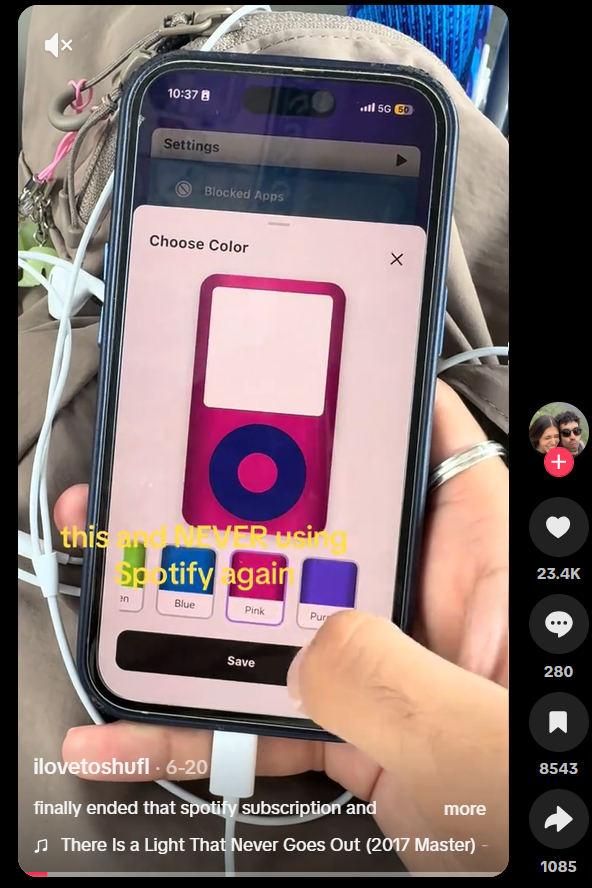
Two things make it work:
- The UI carries the video. Most UGC needs a face hook and storytelling to earn the app demo. This app’s UI is so instantly understandable and eye-catching that a lot of videos skip the face entirely and go straight to the demo. If your app doesn’t look like anything, this format is closed to you.
- It rides a real trend. Retro is everywhere right now, half of New York is back on wired headphones. Hopping on an existing cultural wave always beats trying to create one.
On TikTok, UI is the marketing. If your demo can’t resolve the tension of the hook, the video dies.
Jay on scaling UGC
Jay runs one of the biggest UGC operations we know for his travel social app Nomad Table, with around 20% of daily new users now coming from word-of-mouth. Here’s what he shared:
On scaling creators without losing your mind: Writing over automation. Jay manages creators himself, but everything is documented: video rules, comment replies, onboarding steps, and playbooks. If someone messes up, he points them back to the docs. The goal is to minimize situations where creators need his help directly.
On getting started: Make the content yourself first. Don’t offload it because “you’re an engineer, not a marketer.” UGC is basically engineering: tweak variables, run experiments, see what moves. Get your first users yourself, then scale with other people. If you don’t understand the content, you can’t manage it.
On when to hire your first creators: Only after you have a repeatable format with several viral videos behind it. Hiring creators before that is usually wasted money. Finding the format is the founder’s job. Don’t hand them the app and “let them cook.”
On copycats: He used to get mad when people copied his formats. Not anymore. If a format wins, it will get copied. So detach emotionally and unload the clip. Exploit it while it’s alive, because every format has a limited lifetime. Meanwhile, keep testing new ones so you’re not caught off guard when it dies.
Dan on Meta ads
The problem with organic: if you don’t go viral, your growth engine stops. Paid fixes that. If your ROAS is positive, you can scale basically infinitely, as long as you keep feeding it creatives. Dan’s helped apps double revenue in 2 months this way.
Key things that changed:
- Meta’s algorithm went from interest-based to creative-based. The targeting doesn’t win anymore, it’s the creative that does
- Meta prefers organic-looking videos over polished ads. If your ad makes people close Instagram, Meta punishes you and stops pushing it. UGC-style content keeps people on the platform, so it gets rewarded.
- Boosting your best organic videos is one of the most-used plays. You need a Spark code (TikTok) or partnership code (Meta). But be careful on selecting them because a video that drives views but no conversions is not worth boosting.
- Use paid to test formats faster. Instead of spamming 60 organic videos to see if a new format works, put $100–200 behind one video and read the conversion data. Much faster learning loop.
One from Dan’s e-com friend scaled to $20M in 6 months selling whitening strips and shared: show the result in the first 3 seconds. That’s the whole playbook.
—
Make sure to tune in to our next live session.
Leave a Reply