
Duolingo might be the most copied consumer app of the last two years, not because founders want to teach languages, but because “Duolingo for X” instantly explains what a new product does.
We’ve now seen the same playbook work across Christianity, gaming, coding, fitness and history, turning a familiar comparison into millions of views and meaningful revenue.
Manna → Duolingo for Christians
Manna is a Bible study app that turns learning Scripture into daily Duolingo-style lessons. Last month, it generated $30K MRR and 20K downloads.
From the sheep mascot to the streaks, nearly every part of Manna reinforces the idea that it’s “Duolingo for Christians.”
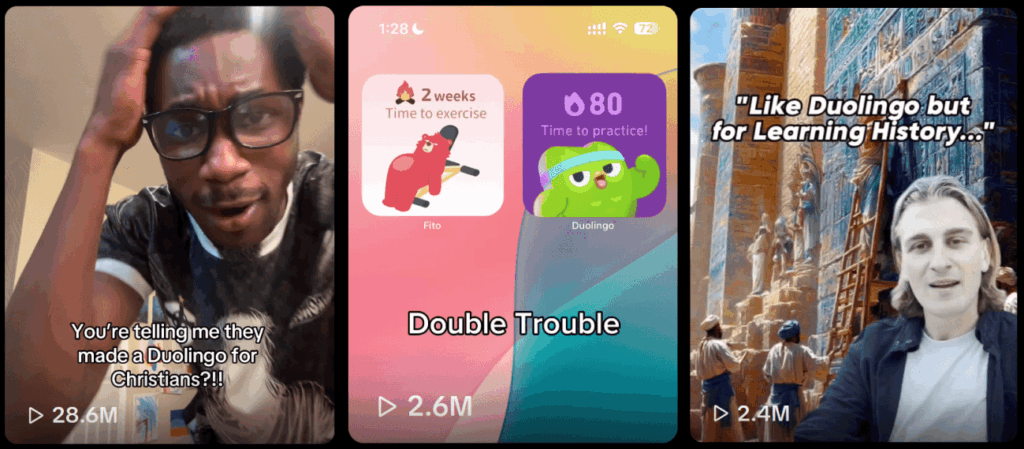
In May 2025, Christian creator @chibforchange opened a video with:
“You’re telling me they made Duolingo for Christians?!”
Although the campaign was partially boosted, it still generated 54K saves and 4.4K comments, showing genuine interest well beyond paid reach.
Porotective → Duolingo for League of Legends
Porotective launched just four months ago, turning League of Legends coaching into Duolingo-style lessons.
It’s already in the Top 100 for Productivity across 20 European countries.
Every lesson starts with a real in-game situation, lets players make the next call, then reveals the correct answer.
One creator opens with “YO, Duolingo just dropped a League of Legends course” before jumping straight into the app.
The video follows the classic shocked-face UGC format before jumping straight into gameplay.
Fito → Duolingo for Fitness
Fito launched in September 2024, turning workouts into Duolingo-style daily challenges. Today, it generates around 10K monthly downloads and $6K MRR.
Fito took a different route. Instead of relying on creators, almost every video simply shows the Fito and Duolingo widgets sitting side by side on the same home screen.
They’ve repeated the same side-by-side widget format for months, turning Duolingo itself into the visual hook.
SideMe → Duolingo for Coding
SideMe launched last year to teach Python through Duolingo-style lessons, and last month hit 20K downloads.
After months of little traction, one TikTok format finally broke through.
The series was simple: “30 Days to Learn Python.”
One video reached nearly 10M views and 110K saves, giving the team a repeatable series to build on.
Every lesson feels like Duolingo, except you’re solving Python instead of Spanish.
Paladin → Duolingo for History
Paladin turned history into short daily challenges and has already grown to $50K MRR.
Its biggest TikTok opens with just:
“They made Duolingo for history lovers.” 4.8M views
Another version reached 2.4M, proving the comparison worked just as well with a different format.
The Duolingo shortcut
Every one of these founders started with the same question:
“What already exists that millions of people instantly understand?”
For these five apps, the answer happened to be Duolingo.
Duolingo won’t fit every product, but the principle applies almost everywhere: starting with something people already understand is often easier than introducing something entirely new.
If you’re considering borrowing Duolingo’s UI or positioning, we also broke down the biggest pros and cons of that strategy here.
Leave a Reply